Technical animation for aerospace and defense
Animation of systems no camera can reach, booth loops and recruiting films, with your release review built in.
Send a brief- You send
- Material released for this use, booth specs
- You get first
- A production plan with your review gates dated
- Delivered
- Animations, booth loops, recruiting cuts, stills
- Stays with you
- Public-release and export-control decisions
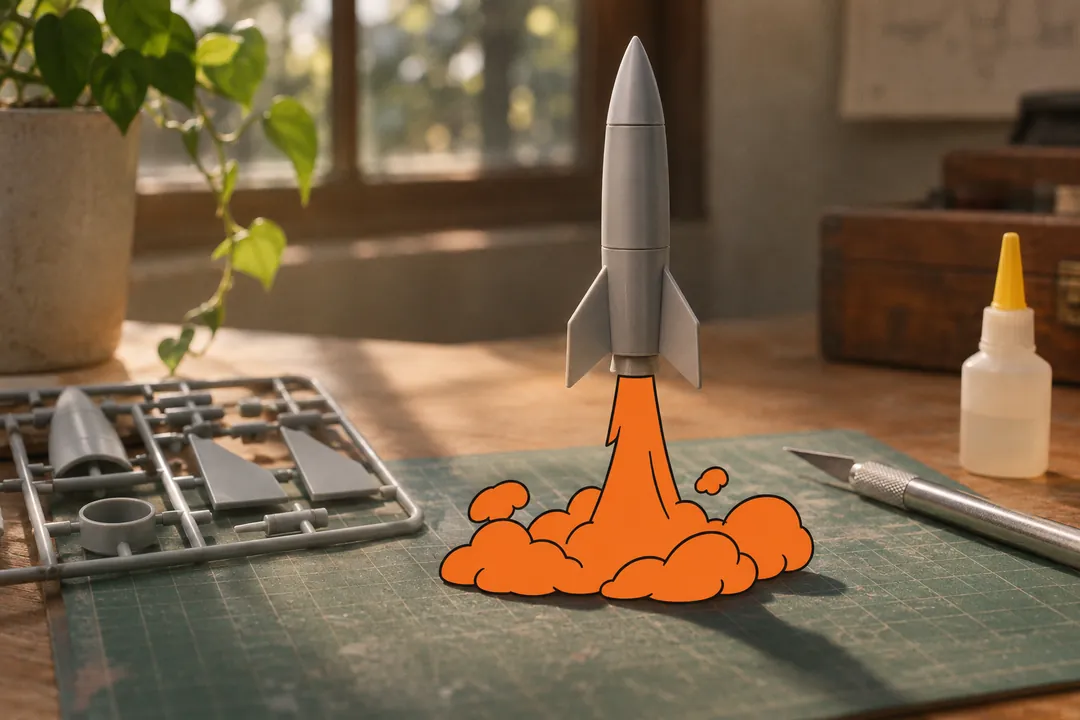
Most of what an aerospace or defense company builds cannot be filmed for an ad. It is in orbit, inside a clean room, still in design, or not released for public view. Animation and 3D can show how a system works without a camera ever reaching it, and live action can still carry the people who build it. Blendpipe plans this work so your own reviewers decide what may be shown, and the schedule gives them the time to decide it.
What we make for aerospace and defense teams
Technical animation
Deployment sequences, mission profiles, how a subsystem works, exploded views of an assembly, the path of a signal. The 3D models are built only from material you have released for this use: approved drawings, simplified outlines, public renders or reference photos. The level of detail is a decision written into the plan. Simplified or generic geometry often explains the principle just as well, and it keeps design detail out of the frame. See 3D and CGI and 2D animation.
Trade-show loops
Booth screens often play without sound, loop all day and are read from across an aisle. A loop is planned around those conditions: large on-screen text, one idea per scene, a clean loop point so the end runs back into the start, and the exact pixel size, file format and playback device from the venue’s or AV vendor’s spec sheet. The file size and bitrate calculator checks a loop against a player’s limits.
Recruiting content
Engineers and technicians talking about the work, the place and the problems they solve. Interviews, facility footage and animated inserts are planned together, and filming covers only the areas your security team approves, with the escort and photography rules you set. Each person on camera signs a release, and their usage terms go into the rights sheet. For LinkedIn, the platform’s video ads page recommends 15 to 30 seconds and a 4:5 frame (720 x 900), with captions as SRT files. See live action.
Your review stays with you
Public-release review and export-control review are your company’s decisions, made by your own reviewers under your own procedures. Blendpipe’s role is production. We do not decide what is releasable, and the plan works on the basis that every file we receive has already been released for this use by the people who decide that.
The review is built into the schedule as dated steps, not left to the end:
- At the brief. You name the reviewers and tell us how long each review takes. The schedule is built around those times.
- Input register. Every file we receive is listed with its source, its date and the person who sent it, so reviewers see what the animation is built from.
- Script and boards. The reviewers see everything that will be shown or said before anything is modeled or filmed.
- Greycard and animatic. Geometry, motion and camera angles are checked untextured, before final rendering.
- Final cut and every version. The finished film, each cutdown, the captions and the stills are reviewed before release, because a short version can change what a scene appears to say.
Production does not move past a review step until your reviewer signs it off, and the estimate states what a returned review costs to rework. Client material is not put into AI tools whose terms allow training on it unless you agree in writing, and if your policy rules out AI-assisted tools for a project, the blend map shows that no shot uses them. The full rules are on AI practices.
Example (fictional). Corvaline is an invented maker of star trackers for small satellites, not a client, and every figure here is an illustration. It needs a 60-second technical animation for its website, a 30-second silent loop for a booth screen and a 30-second recruiting cut. The star tracker is modeled from a simplified outline drawing Corvaline released for marketing, not from engineering CAD, and the satellite around it is generic. The 7-week schedule has three review steps with a named Corvaline reviewer: script and boards in week 2, greycard animation in week 4, and the final cut with all versions in week 7. The animation is 60 seconds at 24 fps, or 1,440 frames; at 4 minutes per frame on 4 machines, one render pass takes 24 clock hours. The booth loop plays at 3840 x 2160 from the venue’s media player; at 20 Mbps with no audio, 30 seconds comes to 75 MB.
What you provide and what you receive
You provide:
- drawings, renders, photos and specifications already released for this use
- the names of your reviewers and the time each review needs
- booth and AV specs (screen size, resolution, player, file format)
- recruiting interviewees, facility access rules and an escort, and your brand guide
You receive:
- the production plan first, with the review steps dated in the schedule
- the input register, the script and boards, the animatic and the greycard review
- the technical animation, booth loops, recruiting cuts and stills, named to the matrix, with caption files
- the rights sheet and the provenance log
Blendpipe’s office is in Colorado Springs; meetings there are by appointment, and most collaboration is remote.
Services and tools that apply
Technical work centers on 3D and CGI and 2D animation, with live action for recruiting films and post-production for captions, sound and finishing. Campaign versioning produces the booth, web and social versions from one master.
The render time calculator shows what a render pass costs before the schedule is set, and the delivery specs checklist covers the export details. The seven stages are on how we work.
Planning a trade show, a product reveal or a recruiting push? Send a brief with what has been released, who reviews it and where it will play, and the first thing you receive is the production plan.