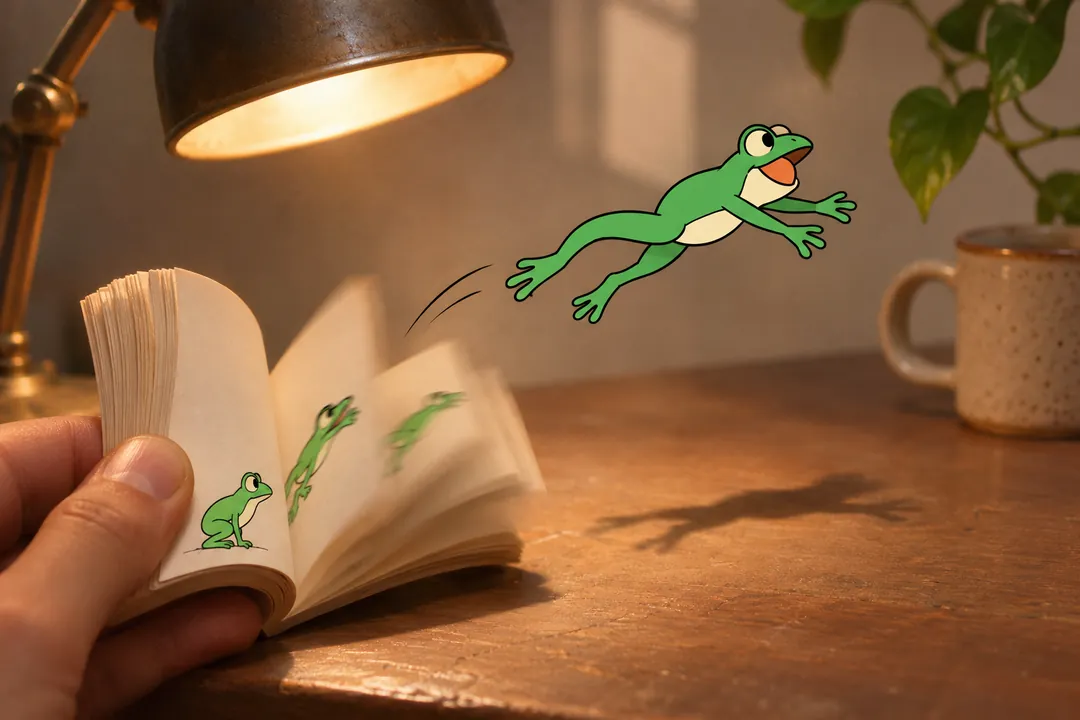
2D animation and motion graphics
Explainers, kinetic type, character and data animation, used where drawing says it better than a camera.
Send a brief- You send
- Script or key message, brand guide, placements
- You get first
- Style frames and an animatic timed to the voiceover
- Delivered
- Final animation in every agreed length and ratio
- Often paired with
- Live action plates and 3D product shots
Shot 1, 0:00 to 0:04
Ridge at dawn
- Live action
- AI-assisted
A runner crests a frosted ridge as the sun clears the horizon.
Why this medium: Only a real location sells cold air and early light. An AI-assisted cleanup removes a power line from the sky; a compositor reviews every frame.
Shot 2, 0:04 to 0:07
First sip
- Live action
- Animation
At the trailhead the runner pours coffee; a drawn line rises out of the steam.
Why this medium: The animated line is the idea of the spot (heat that lasts), so it starts inside a real moment.
Shot 3, 0:07 to 0:12
The line becomes a chart
- Animation
The line stretches across the frame into a simple temperature curve from 6 a.m. to noon.
Why this medium: A chart is clearer drawn than filmed, and it can be retimed for every cutdown.
Shot 4, 0:12 to 0:17
Inside the wall
- 3D
The bottle separates into its layers: outer steel, vacuum gap, copper lining, inner steel.
Why this medium: A camera cannot show a vacuum gap. A 3D model built from the product drawings can, accurately.
Shot 5, 0:17 to 0:20
Back on the trail
- Live action
- 3D
- Animation
- AI-assisted
The 3D bottle sits in the runner’s real hand; the drawn line wraps around it.
Why this medium: The blended shot joins the three media. AI-assisted rotoscoping speeds the hand matte; a person finishes the edges.
Shot 6, 0:20 to 0:24
Summit pour
- Live action
At the top, the runner pours and the steam is still there.
Why this medium: The proof moment stays real: the same coffee, the same bottle, filmed hours later.
Shot 7, 0:24 to 0:27
Twelve hours
- Animation
Kinetic type: twelve hours hot, twenty-four cold.
Why this medium: Type animates cleanly in every aspect ratio and language version.
Shot 8, 0:27 to 0:30
Packshot
- 3D
The bottle turns once and settles on the end card.
Why this medium: A rendered packshot is identical in every version and can be re-rendered for a new color.
Animation is the part of an ad that can show what a camera cannot: a temperature that holds for twelve hours, a workflow inside software, a mechanism inside a product, a sentence that has to land in six seconds. Blendpipe uses 2D animation and motion graphics where drawing says it more clearly than footage, and keeps live action and 3D for the moments that need real light or an accurate object.
The blend map above shows where 2D carries the fictional Orlenna spot: the line that rises out of the coffee steam, the chart it becomes, the line that wraps the bottle in the blended shot and the closing type. Fourteen of the thirty seconds use drawn elements, and only two of those shots are animation alone.
What we animate
Explainers
A product or a process explained in sequence: what it does, in what order, and why the order matters. Explainers work best when the script has one idea per scene and the visual language is fixed early, so every scene reads as part of one film. Typical lengths are 30 to 90 seconds for paid placements and longer for a product page or a trade show screen.
Kinetic type
Words that move with the voiceover or replace it. Kinetic type carries offers, numbers and claims in social placements where many viewers watch without sound, and it reflows cleanly between 16:9, 9:16, 1:1 and 4:5 because type can be re-laid out for each frame rather than cropped.
Character animation
Drawn characters or mascots that act a scene. Character work needs the most development time: turnarounds, expressions and a walk or gesture test before a full scene is animated. Characters based on a real person need that person’s written consent; Blendpipe does not draw a recognizable real person without it.
Data and diagram animation
Charts, maps, timelines and diagrams that build in the order a viewer should read them. A claim shown as a chart must match the evidence the brand holds for it, so the numbers come from the client’s substantiation, not from the animator.
When 2D is the right choice
The blend map records a reason for every medium. 2D animation usually wins when:
- The subject is invisible or abstract. Heat, signal, savings, a sequence of steps or a feeling has no shape a camera can record.
- The message must survive every format. Animated type and graphics can be rebuilt for each aspect ratio instead of losing the edges of a frame. The aspect ratio crop calculator shows how much of a 16:9 frame survives a 9:16 crop: about 32 percent.
- The schedule or budget cannot carry a shoot. A short spot built from style frames and type can move from script to final without a shoot day, crew or location.
- It joins other media. Drawn elements composited over live action or 3D are the core of mixed-media work: a line, a highlight or a character interacting with a real scene.
Live action is usually better for people, places and texture that the audience should trust as real. 3D is usually better for an accurate product, especially its inside. Many briefs end up using all three.
How an animation job runs
- Script timing. The voiceover is timed against the spot length before anything is drawn. At 150 words per minute a 42-word script reads in 16.8 seconds; the script timing calculator checks your own script.
- Style frames. Two to four finished stills that fix the line, color, texture and type. They are approved before animation starts, because every later frame follows them.
- Storyboard and animatic. The boards are cut to the recorded or scratch voiceover so the timing is approved while changes are cheap. See creative development.
- Animation. Key poses first, then motion, then secondary motion and finishing. Reviews happen at agreed points in the schedule, not at random.
- Versions. Each length and ratio in the deliverable matrix is built from the master project, with type and graphics re-laid out rather than cropped where that reads better. See campaign versioning.
Example (fictional). In the Orlenna spot, the 2D line starts inside a live-action shot (the steam over the coffee at 4 seconds), becomes a full-frame chart from 7 to 12 seconds, wraps around the 3D bottle from 17 to 20 seconds and returns as kinetic type from 24 to 27 seconds. Because the line is drawn, the same idea survives the 6-second cutdown, where only the chart and the type remain.
What you send and what you get
You send the script or the key message, the brand guide (fonts, colors, logo rules), any existing illustration or character designs, the placements and lengths, and the claims the animation will show with the evidence behind them.
You receive the style frames, the animatic, the final animation in every agreed length and ratio, caption files, and, if the contract includes them, the layered project files. The rights sheet lists any licensed fonts, music or stock elements and their terms.
Where AI-assisted tools fit
AI-assisted tools can help with early concept frames, cleanup and in-between drawings. Any such step is listed in the provenance log with the person who reviewed it, as described on AI practices. This matters for ownership: the US Copyright Office’s guidance says copyright protects material that is the product of human creativity, and material generated from a prompt alone must be disclaimed in a registration. Style frames, layouts and key animation drawn by people remain human-authored work.
Ready to plan an animated spot or the animated parts of a larger campaign? Send a brief with the script or message, the placements and the deadline, and the first thing you receive is the production plan.