Example campaign: a fictional plan for Orlenna
An invented brand and a complete plan, showing what you would receive before production is committed.
Send a brief- Status
- Fictional: Orlenna is not a client
- Hero spot
- 30 seconds, 8 shots, 24 fps
- Deliverables
- 24 (3 lengths x 4 ratios x 2 languages)
- Schedule
- 8 weeks from plan to delivery
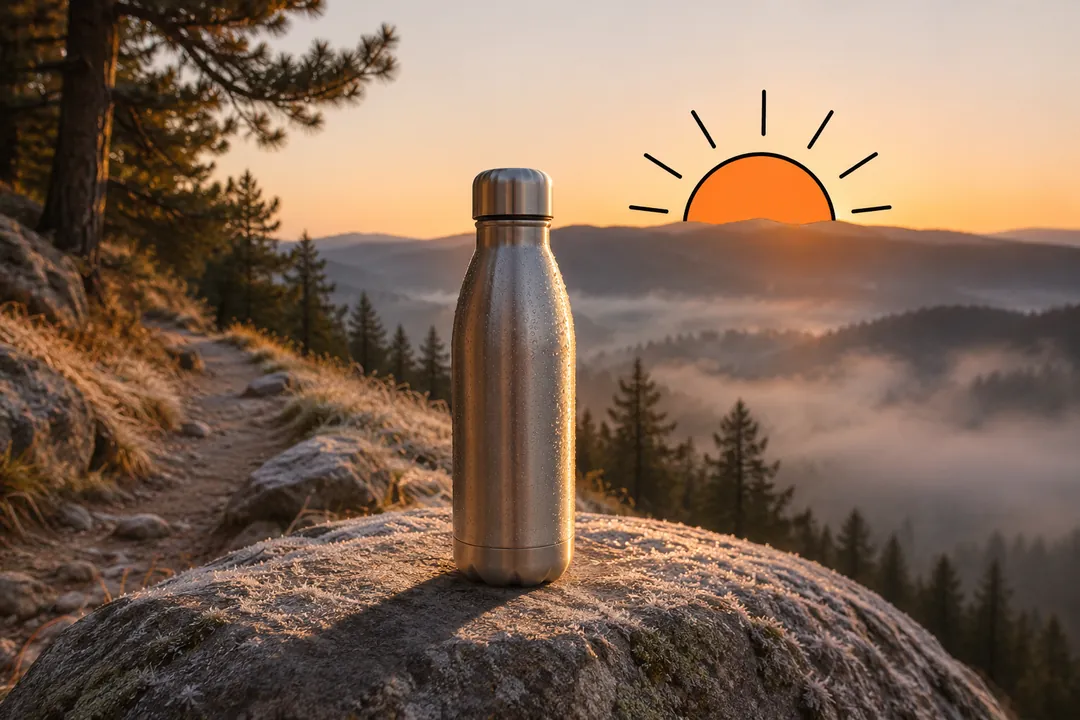
Shot 1, 0:00 to 0:04
Ridge at dawn
- Live action
- AI-assisted
A runner crests a frosted ridge as the sun clears the horizon.
Why this medium: Only a real location sells cold air and early light. An AI-assisted cleanup removes a power line from the sky; a compositor reviews every frame.
Shot 2, 0:04 to 0:07
First sip
- Live action
- Animation
At the trailhead the runner pours coffee; a drawn line rises out of the steam.
Why this medium: The animated line is the idea of the spot (heat that lasts), so it starts inside a real moment.
Shot 3, 0:07 to 0:12
The line becomes a chart
- Animation
The line stretches across the frame into a simple temperature curve from 6 a.m. to noon.
Why this medium: A chart is clearer drawn than filmed, and it can be retimed for every cutdown.
Shot 4, 0:12 to 0:17
Inside the wall
- 3D
The bottle separates into its layers: outer steel, vacuum gap, copper lining, inner steel.
Why this medium: A camera cannot show a vacuum gap. A 3D model built from the product drawings can, accurately.
Shot 5, 0:17 to 0:20
Back on the trail
- Live action
- 3D
- Animation
- AI-assisted
The 3D bottle sits in the runner’s real hand; the drawn line wraps around it.
Why this medium: The blended shot joins the three media. AI-assisted rotoscoping speeds the hand matte; a person finishes the edges.
Shot 6, 0:20 to 0:24
Summit pour
- Live action
At the top, the runner pours and the steam is still there.
Why this medium: The proof moment stays real: the same coffee, the same bottle, filmed hours later.
Shot 7, 0:24 to 0:27
Twelve hours
- Animation
Kinetic type: twelve hours hot, twenty-four cold.
Why this medium: Type animates cleanly in every aspect ratio and language version.
Shot 8, 0:27 to 0:30
Packshot
- 3D
The bottle turns once and settles on the end card.
Why this medium: A rendered packshot is identical in every version and can be re-rendered for a new color.
Shot list (fictional)
| Shot | Time | What we see | Medium | Why |
|---|---|---|---|---|
| 1 | 0:00 to 0:04 | A runner crests a frosted ridge as the sun clears the horizon. | Live action + AI-assisted | Only a real location sells cold air and early light. An AI-assisted cleanup removes a power line from the sky; a compositor reviews every frame. |
| 2 | 0:04 to 0:07 | At the trailhead the runner pours coffee; a drawn line rises out of the steam. | Live action + Animation | The animated line is the idea of the spot (heat that lasts), so it starts inside a real moment. |
| 3 | 0:07 to 0:12 | The line stretches across the frame into a simple temperature curve from 6 a.m. to noon. | Animation | A chart is clearer drawn than filmed, and it can be retimed for every cutdown. |
| 4 | 0:12 to 0:17 | The bottle separates into its layers: outer steel, vacuum gap, copper lining, inner steel. | 3D | A camera cannot show a vacuum gap. A 3D model built from the product drawings can, accurately. |
| 5 | 0:17 to 0:20 | The 3D bottle sits in the runner’s real hand; the drawn line wraps around it. | Live action + 3D + Animation + AI-assisted | The blended shot joins the three media. AI-assisted rotoscoping speeds the hand matte; a person finishes the edges. |
| 6 | 0:20 to 0:24 | At the top, the runner pours and the steam is still there. | Live action | The proof moment stays real: the same coffee, the same bottle, filmed hours later. |
| 7 | 0:24 to 0:27 | Kinetic type: twelve hours hot, twenty-four cold. | Animation | Type animates cleanly in every aspect ratio and language version. |
| 8 | 0:27 to 0:30 | The bottle turns once and settles on the end card. | 3D | A rendered packshot is identical in every version and can be re-rendered for a new color. |
Voiceover, 42 words at 150 words per minute, reads in 16.8 seconds; with 6 seconds of music-only moments the cut has room to spare. Script: "Six a.m. on the ridge. Coffee poured at the trailhead is still hot at the top. Two steel walls, a vacuum between them, and a copper layer that keeps heat where you put it. Orlenna Ridge Bottle. Twelve hours hot. Twenty-four cold."
Deliverable matrix (fictional)
| Length | 16:9 | 9:16 | 1:1 | 4:5 |
|---|---|---|---|---|
| 30 s | English, Spanish | English, Spanish | English, Spanish | English, Spanish |
| 15 s | English, Spanish | English, Spanish | English, Spanish | English, Spanish |
| 6 s | English, Spanish | English, Spanish | English, Spanish | English, Spanish |
3 lengths x 4 ratios x 2 languages x 1 call to action = 24 deliverables.
Schedule (fictional, 8 weeks)
| Weeks | Stage | Weeks chart | What happens |
|---|---|---|---|
| 1 | Production plan | Brief read back, treatment, blend map, deliverable matrix, rights and AI plan, line-item estimate. | |
| 2 to 3 | Development | Script and voiceover draft, storyboards, style frames, animatic, AI-assisted previs of the ridge shot. | |
| 4 | Shoot and build | One shoot day on a permitted trail location; 3D bottle model built from the product drawings. | |
| 4 to 6 | Animate and render | 2D line and type animation; 3D renders; cleanup and rotoscoping passes with human review. | |
| 6 to 7 | Edit and finish | Edit, composite, color, sound design, licensed music, voiceover record and mix. | |
| 8 | Versions and delivery | 24 deliverables, captions, stills, rights sheet and provenance log. |
Blendpipe is a new studio with no reel, so this page shows the method instead: a complete production plan for a brand that does not exist. Orlenna is an invented Colorado brand and not a client, the Ridge Bottle is not a real product, and every name, date, count and dollar figure is an illustration. The blend map, shot list, matrix and schedule above use the same fictional data; this page explains the decisions behind them.
Example (fictional). Orlenna is launching the Ridge Bottle, an insulated trail bottle. The brief asks for a 30-second hero spot plus cutdowns for paid social, online video, the product page and a trade show screen: 30, 15 and 6 seconds, four aspect ratios, English and Spanish. The audience is trail runners and day hikers, 25 to 45, who carry coffee or tea on early starts. The one message: hot at the trailhead, still hot at the top. Orlenna supplies its brand guide, CAD files and last season’s trail footage. The claims (twelve hours hot, twenty-four cold) are placeholders a real brand would have to substantiate.
The treatment (fictional)
One idea carries the spot: heat that lasts, drawn as a single warm line. A runner crests a frosted ridge at dawn and pours coffee at the trailhead. A drawn line rises out of the steam, stretches into a temperature curve, then cuts inside the bottle wall to show why the heat stays. Back on the trail, the line wraps the bottle in the runner’s hand, and at the summit the coffee is still steaming. The spot closes on type and a packshot. The look is cold morning light against one warm line, a thread through all four media.
Why each shot is in its medium
Read by medium, the blend map gives these reasons. A shot can use several media, so the seconds add up to more than 30.
- Live action, 14 seconds (shots 1, 2, 5 and 6). Only a real location sells cold air and early light, and the summit pour is the proof moment, so it stays real: the same coffee, filmed hours later. The plan has one shoot day on a private trail, with the owner’s written permission. Because a 9:16 crop keeps about 32 percent of a 16:9 frame, the runner and the bottle are framed inside the vertical area on the day.
- 2D animation, 14 seconds (shots 2, 3, 5 and 7). The line is the idea, so it starts inside a real moment, becomes a chart that reads more clearly drawn than filmed, and returns as kinetic type that re-lays out for every ratio and language.
- 3D, 11 seconds (shots 4, 5 and 8). A camera cannot show a vacuum gap. A model built from the product drawings shows the wall accurately (outer steel, vacuum gap, copper lining, inner steel), and the packshot is identical in every version. The 264 frames (11 seconds at 24 fps) take 6.6 clock hours per pass on 4 machines, 19.8 for three passes, so the greycard review comes before the first full pass.
- AI-assisted, 7 seconds (shots 1 and 5). A cleanup step removes a power line from the dawn sky, and a rotoscoping step speeds up the hand matte in the blended shot. A compositor reviews the cleanup frame by frame, and a person finishes the matte edges.
Shot 5 is where all four tracks meet. The location is private land, where only the owner’s permission is needed; a Colorado Springs city park would need a permit 14 days ahead, and drone permits there are not currently available, so the plan has no drone shots.
Voiceover timing
The 42-word script printed under the shot list reads in 16.8 seconds at 150 words per minute. The cut plans 6 seconds of music-only moments, which brings the total to 22.8 seconds and leaves 7.2 seconds of the 30. The margin lets the read breathe and leaves room for the Spanish version’s own timing check. The script timing calculator runs the same arithmetic on your script.
The rights sheet (fictional)
| Asset | Licensor type | Term | Media | Territory | Renewal |
|---|---|---|---|---|---|
| Music track | Production library controlling composition and recording | 12 months: March 1, 2027 to February 29, 2028 | Online video, paid social, product page, trade show | United States | Reminder January 30, 2028 |
| Voiceover, English and Spanish | Two voice performers | 12 months, counted in 13-week cycles | Same as music | United States | Cycles end May 30, 2027; August 29, 2027; November 28, 2027; February 27, 2028 |
| On-camera runner | Performer, with signed release | Same term and cycles as the voiceover | Same as music | United States | Same as the voiceover |
| Trail location | Private landowner | One shoot day; footage use per the release | All media in the plan | Not limited | None |
| Brand typeface | Type foundry, licensed to Orlenna | Orlenna’s existing license | Production files only; not redistributed | As licensed | Orlenna’s own renewal |
| 3D bottle model | Built by Blendpipe from Orlenna’s drawings | Ownership as set in the contract | All media in the plan | Not limited | None |
The music needs both halves licensed, because the US Copyright Office notes that a producer needs sync licenses from the owner of the composition and the owner of the recording; a library that controls both can grant them in one agreement. The 12-month term holds 4 full 13-week cycles plus 2 days. No stock footage is used; Orlenna’s own trail footage appears only in the animatic. The usage term calculator produces these dates from the first-use date.
The AI disclosure plan (fictional)
| Step | Shot | Tool category | Reviewer role | Disclosure decision |
|---|---|---|---|---|
| Previs of the ridge shot | 1 | Generative image model | Director | Planning only, in no delivered file: no label |
| Power line removal | 1 | AI-assisted cleanup | Compositor, frame by frame | Proposed as a minor edit: no YouTube disclosure, no TikTok label; logged |
| Hand matte | 5 | AI-assisted rotoscoping | Compositor, who finishes the edges | Production help that adds no imagery: no label proposed; logged |
| Spanish caption draft | All versions | Machine translation | Fluent Spanish reviewer | Text only: no label proposed; the Spanish voiceover is read by a person |
The platform rules behind these decisions, checked November 22, 2026:
- YouTube requires disclosure of realistic altered or synthetic content, such as altered footage of real events or places, but not of minor edits or production help. It may label files carrying C2PA metadata automatically, even where disclosure is not required.
- TikTok requires a label on AI-generated or significantly edited content that shows realistic scenes or people. Removing a power line does not change the scene.
- Meta shows an “AI info” label based on industry-standard indicators and self-disclosure; for content only edited with AI, it sits in the post menu. Its political ad rule does not apply here.
- New York requires conspicuous disclosure of a synthetic performer in a commercial ad. This plan has no synthetic people, synthetic voices or digital replicas.
Blendpipe proposes; Orlenna’s counsel decides. See AI practices.
The estimate structure
The plan closes with a line-item estimate. The figures below are the default example values of the video budget calculator: illustrations of the structure, not Blendpipe prices and not market rates.
| Line (example values) | Calculation | Amount |
|---|---|---|
| Live action | 1 shoot day x ($9,500 crew + $2,800 equipment) + $1,200 locations | $13,500 |
| 2D animation | 14 seconds x $450 | $6,300 |
| 3D | 3 shots x $3,200 | $9,600 |
| Edit, color and sound | 6 post days x $1,400 | $8,400 |
| Versions | 23 extra versions x $180 | $4,140 |
| Music license | One license | $2,500 |
| Subtotal | $44,440 | |
| Contingency | 10% | $4,444 |
| Total | $48,884 |
The production budget worksheet adds development ($7,200), the 3D model ($2,400) and voiceover ($1,500): subtotal $55,540, contingency $5,554, total $61,094, again as example values. In a real plan, each line states its assumptions and what would change it.
What Orlenna would receive at handover
- 24 deliverables, each named to the matrix by campaign, length, ratio, language and version.
- English and Spanish caption files (SRT or VTT) for every version.
- Stills and project files as agreed, including the 3D model if the contract covers it.
- The rights sheet above, with every renewal date.
- The provenance log of the four AI-assisted steps and their reviewers.
See deliverables for the full package, or send a brief for a plan like this for your product.